Grammar Chaos: Altogether Is Not the Same as All Together
Posted on Jun 06, 2018
One of the most difficult things about learning and mastering the English language is that a lot of words sound too alike. Sometimes, this is also because new words are formed by combining already-existing words together.
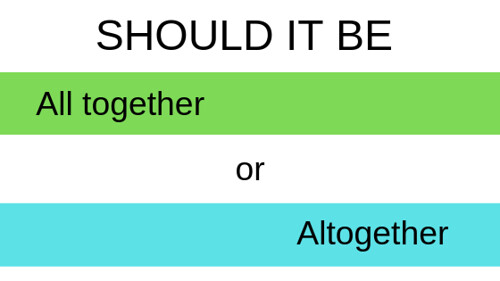
For this round, we’ll be discussing the words altogether and all together. Here are some sentences which use both forms. Can you guess which pair of sentences uses them correctly?
- I took all of my general education classes all together this semester.
- I decided to drop them and extra-curriculars altogether.
- My brother is seeing his choir group and soccer team all together this Saturday.
- The last they were altogether was at their high school graduation.
If you thought the first pair of sentences is correct, then you probably don’t need this lesson anymore.
Altogether is an adverb of manner. It answers the question “how.” The word means “taken as a whole” and is synonymous with “completely,” “totally,” and “wholly.” Sometimes, altogether can also be used to mean “outright.” It can never be separated into two words and can never be used as anything other than an adverb. Here are some examples.
- The team managed to collect donations altogether worth $5,000.
- He was so sleepy that he skipped a shower, a meal, and dessert altogether.
- The school board didn’t release a prom clothing guide for this year. They just banned dances altogether.
All together, the two-word form, is a phrase which is used in all other ways besides as an adverb. The phrase means “in a group,” “in the same place or at the same time,” “with each other,” and basically everything else, just not as an adverb. Here are more examples.
- Dean put his books all together on one shelf.
- The conductor lifted his hand: “All together now!”
- I gathered our bandmates all together for this gig.
That should be easy enough to understand, but you’ll need some tricks to remember it. If you can replace all together with all here or replace altogether with completely, then you’re on the right track.
Got a grammar question bugging you? Shoot us a message! Are you an educator, a writer, or an ESL learner? Our blog Grammary has more in store for you! Keep reading for more chaotic English grammar explained.
Sources:
- Altogether vs. All Together
- All together vs. altogether
- All Together vs. Altogether
- Altogether and All Together
- Confusing Words - altogether vs all together
- Altogether or all together?
- Altogether vs. All Together: What’s the Difference?
Disclaimer: Image is not ours. Credit to the owner.
About 1-Hour Proofreading
1-Hour Proofreading is a growing start-up offering fast and efficient editing services at a reasonable price, with the assurance that the document is publication-ready the soonest you need it. Its team of highly competent professional editors is committed to helping those in need of quality editing services while facing tough deadlines.
Visit 1hourproofreading.com for more details.
Follow us:
Back to Grammary