Grammar Chaos: Do the Raven—How to Remember the Difference between Affect and Effect
Posted on Aug 09, 2017
Choosing between two similar words can be daunting, especially when they’re similar in meaning. But with the right knowledge and a keen eye (and maybe a trick or two), you’ll be able to distinguish one from the other easily.
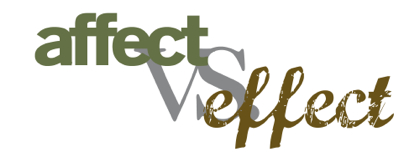
Affect and effect sound way too alike. Despite this, the two of them have very different uses.
Affect with an a is a verb that means “to influence something.”
For example:
Your academic standing can affect your scholarship.
Effect with an e is mostly used as noun, which means “a result.”
For example:
Your academic standing can have an effect on your scholarship.
An effect is something that happens when one object affects another. See the difference? Good. In very rare cases, the roles can be switched. Affect can be a noun, and effect can also be a verb.
Affect can be a noun when used in describing a facial expression or mood.
For example:
You seem to have a melancholic affect today.
Effect is used as a verb to describe something that was caused.
For example:
The president wants to effect change on the criminal law system.
Again, those are very rarely used. So going back to the original thought, there’s an easy trick that can help you remember the difference. When you’re confused about which one to use, think RAVEN. Drop the R and you’re left with A-V-E-N.
Affect, Verb. Effect, Noun.
If you’re still not confident enough, why not have your copy checked by a professional proofreader? 1-Hour Proofreading offers fast and reliable proofreading and copyediting services at a fraction of the cost. Go to our main site to find out more!
Grammar blues got you down? Shoot us a message, and we might be able to help you make sense of how chaotic English grammar can be! See you on the next installment of Grammar Chaos!
Sources:
Disclaimer: Image is not ours. Credit to the owner.
About 1-Hour Proofreading
1-Hour Proofreading is a growing start-up offering fast and efficient editing services at a reasonable price, with the assurance that the document is publication-ready the soonest you need it. Its team of highly competent professional editors is committed to helping those in need of quality editing services while facing tough deadlines.
Visit 1hourproofreading.com for more details.
Follow us:
Back to Grammary